
A Deep Dive into Cinematic Corporate Video and Podcasting
The era of the flat, brightly lit, white background corporate talking head is over. In a digital landscape saturated with high-end content, modern audiences—whether they are stakeholders, consumers, or prospective clients—expect a visual experience that holds their attention.
To build trust and authority, brands are rapidly pivoting toward a “cinematic” visual language for their corporate communications, CEO addresses, and B2B video podcasts.
But “cinematic” is more than just a buzzword. It is a specific set of technical choices involving lighting, optics, set design, and audio fidelity. Here is an advanced breakdown of how to engineer a broadcast-quality, cinematic look for your next corporate production.
1. Advanced Sculpting: The Cinematic Lighting Ratio
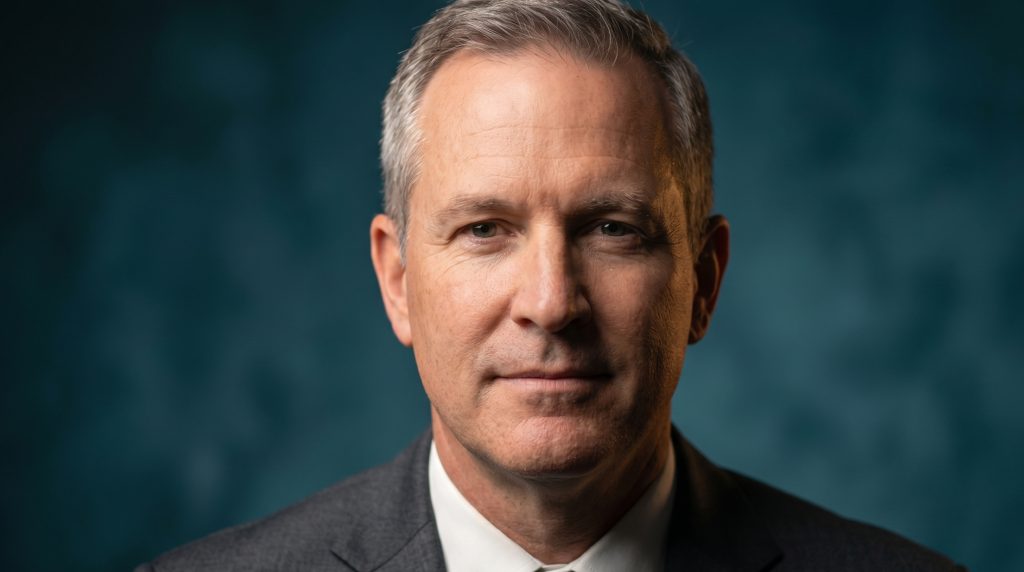
Standard corporate video typically uses flat lighting to eliminate shadows, resulting in a two-dimensional, clinical look. Cinematic lighting deliberately introduces shadows to sculpt the face, add depth, and create a mood.
The Contrast Ratio: Instead of a 1:1 ratio (where both sides of the face are equally lit), cinematic setups often employ a 3:1 or 4:1 lighting ratio. This allows the “fill” side of the subject’s face to drop into shadow, immediately adding a sense of volume and gravity to the speaker.
Motivated Lighting: Every light should feel like it belongs in the environment. If there is a window in the shot, the key light should mimic the direction and colour temperature of that daylight.
Colour Contrast (Teal and Orange): You can elevate a basic interview setup by mixing colour temperatures. Bathing the background in a cooler, subtle blue (teal) while lighting the subject with a warm, daylight-balanced key light (orange) creates natural colour contrast that instinctively draws the viewer’s eye to skin tones.
2. Optics and the Illusion of Depth
A hallmark of high-end production is the physical separation between the subject and their environment. This is achieved through a combination of spatial awareness and specific lens choices.
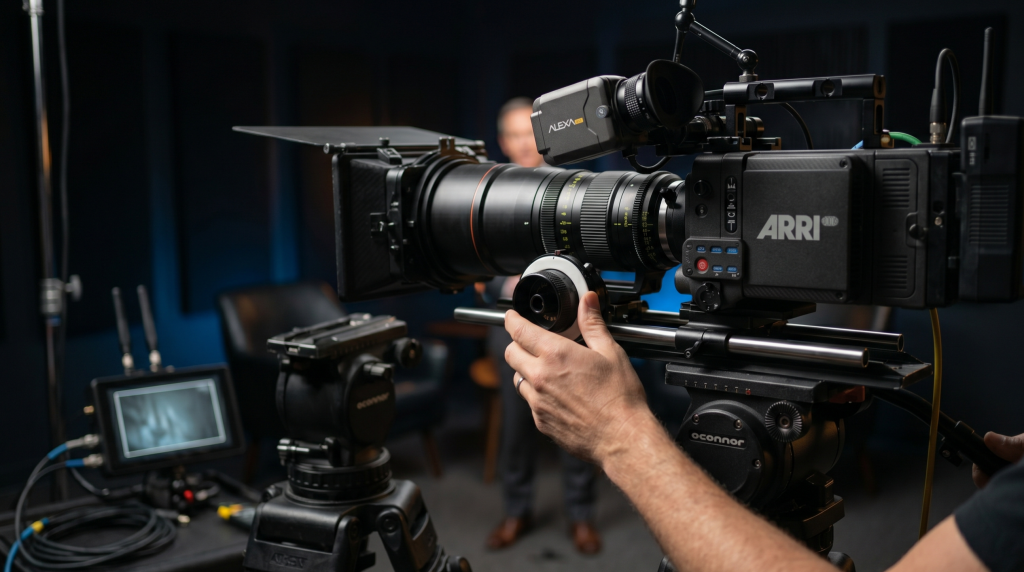
Focal Lengths: Ditch wide-angle lenses (like 24mm or 35mm) which can distort facial features. Opt for short telephoto prime lenses—typically 50mm, 85mm, or even 135mm. These lenses compress the background and render facial proportions accurately and flatteringly.
Shallow Depth of Field: Shooting at a wider aperture (such as f/2.8 or f/4 on a full-frame sensor) throws the background beautifully out of focus. This “bokeh” effect ensures the audience remains focused on the speaker’s expressions and message, rather than the details of the room behind them.
Subject Placement: To achieve this optical separation, you need physical space. Pushing the talent right up against a wall flattens the image. Utilising a room with high ceilings and a deep footprint allows you to place the camera far back, use a longer lens, and leave ample space between the subject and the background.
3. Practical Lighting and Set Dressing
A stark background feels sterile. A cinematic set feels lived-in, warm, and inviting—crucial elements for long-form video podcasts where you want the viewer to feel like a guest in the room.
Introducing Practicals: “Practical lights” are real light sources visible within the frame. A strategically placed Edison bulb, an industrial desk lamp, or subtle neon signage adds visual texture.
Foreground Elements: Shooting through or past something—like the blurred edge of a microphone, a laptop monitor, or a plant—adds immediate foreground depth, creating a complex, multi-layered image.
4. Broadcast-Grade Audio and Streaming Architecture
Cinematic visuals are useless if the audio is hollow, echoed, or out of sync. High-end corporate content demands pristine sound and flawless delivery mechanisms.
Acoustic Control: Recording in an environment built to control sound reflections is paramount. Hardwood floors and glass walls in office boardrooms create audio bounce that ruins podcasts.
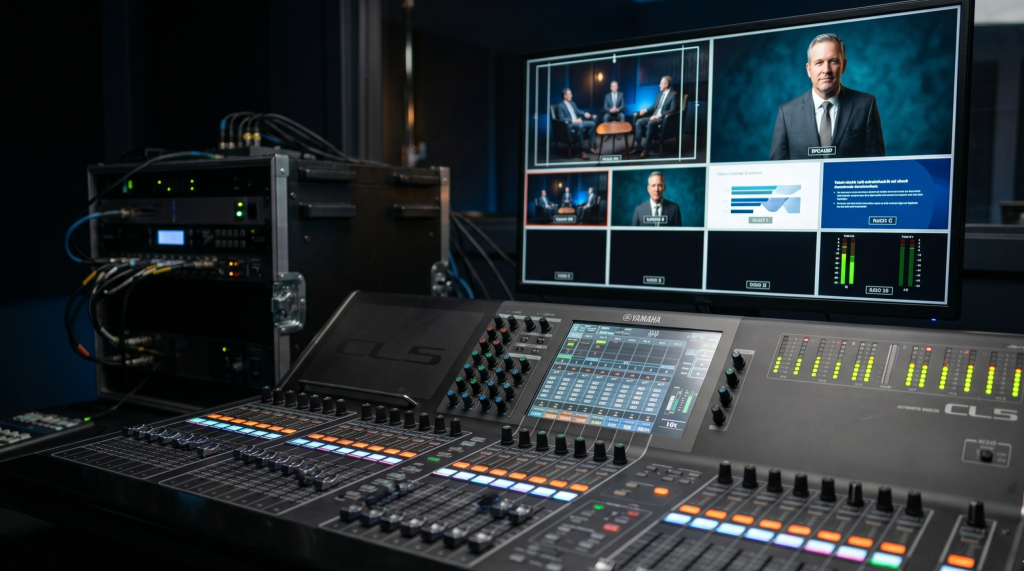
Seamless Integration: For live events, CEO town halls, or interactive podcast recordings, the visual feed must be paired with robust live-streaming architecture. This requires high-speed, stable internet and dedicated webcasting software to ensure no dropped frames or buffering during critical broadcasts.
The Ultimate Production Environment
Executing a cinematic corporate shoot requires total environmental control, and that is precisely what West London Studio is engineered to provide.
Located in W10, our 570 sq. ft. studio features high ceilings and the necessary depth to deploy long lenses and achieve that coveted background separation. With professional continuous lighting gear included in the hire, you can dial in precise lighting ratios and colour temperatures the moment you arrive.
Review your footage instantly on our 50″ 4K monitor, and utilise our dedicated makeup and dressing room to ensure executives and guests look camera-ready. Whether you need a space to execute your own vision, require our robust live-streaming and webcasting capabilities, or want to hand the technical reins over to our full-service video production team, the studio is equipped to capture your brand’s voice.
Our production crew will also be ready to live-stream or film in your premises if that is your preference.
Contact us for more information.